Forex Trading for Beginners
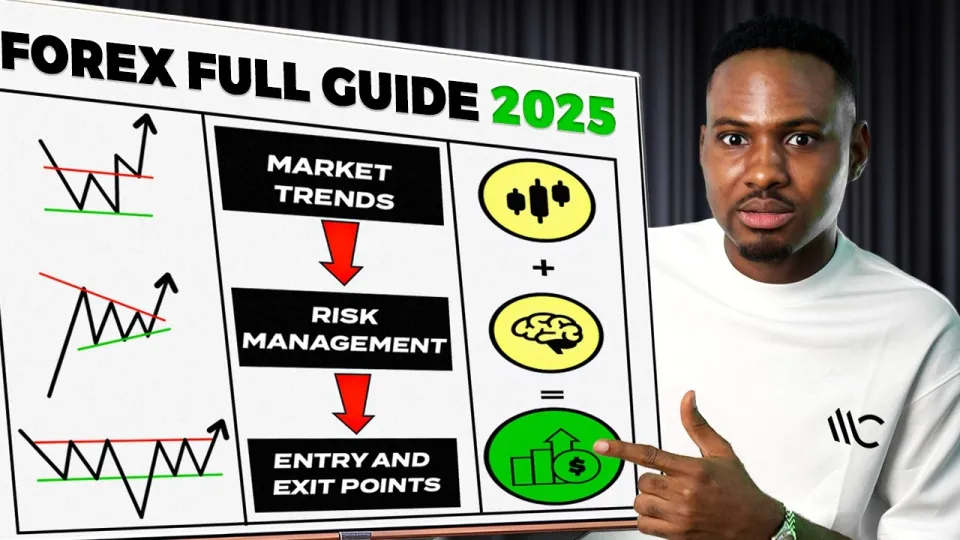
Video: How To Start Forex Trading For Beginners’ 2025 (Full Course)
Want articles like this for your own video to promote it on YouTube and Google? Order them through the Telegram bot @sat_sit_bot. The bot writes and publishes the articles itself (with your YouTube video embedded) on popular topical websites (no ads). Try it free: 50 articles on us.
Forex trading for beginners is the process of learning how currency pairs are quoted, choosing a regulated broker and terminal, practising on a demo account and only then risking real money with a fixed percentage per trade. The full beginner course from Jeffrey Benson Forex follows exactly that path, and students can continue with structured training through the FirePipsFX plans page. Below is the practical version of that roadmap, written to be usable without the video.
What forex is and how currency pairs are quoted
Forex is a decentralised over-the-counter market where national currencies are traded against each other in pairs, and the price of a pair simply shows how much of the quote currency is needed to buy one unit of the base currency. In EUR/USD, the euro is the base and the US dollar is the quote: a price of 1.0850 means one euro costs 1.0850 dollars. There is no single exchange and no closing bell — trading runs from the Sydney open on Sunday evening to the New York close on Friday, roughly 24 hours a day, five days a week.
Three details matter more than anything else at the start:
- Pips and lots. A pip is the standard unit of price movement, usually the fourth decimal place for most pairs and the second for yen pairs. A standard lot is 100,000 units of base currency, a mini lot is 10,000 and a micro lot is 1,000 — micro lots are what a beginner should use.
- Spread and leverage. The spread is the gap between bid and ask and is your first cost on every trade. Leverage multiplies both gains and losses, so a 1:500 account does not mean you should use 1:500 exposure.
- Majors first. EUR/USD, GBP/USD, USD/JPY and USD/CHF have the tightest spreads and the most analysis available; exotic pairs are a later topic.
How the forex market works across the four sessions
The forex market moves because banks, funds, corporations and central banks continuously buy and sell currency, and retail traders only see the result of that flow on their charts. Liquidity is not constant: it rotates around four trading sessions — Sydney, Tokyo, London and New York — and the behaviour of a pair changes with the session that is open.
The London session and the London–New York overlap are where most of the daily range is created, which is why beginners are usually advised to trade the first hours of London rather than the thin hours before Tokyo closes. News releases — central bank rate decisions, CPI and non-farm payrolls — can move a pair 50–100 pips in minutes and widen spreads sharply, so a beginner's first rule should be to stay out of the market for the few minutes around a scheduled release.
Tools every beginner needs before the first trade
A beginner needs a broker, a trading terminal, a charting routine and a journal — nothing more, and nothing expensive. The course recommends a specific broker for 2026 and builds the workflow around MetaTrader 5, which is free and available on desktop, web and mobile.
- Regulated broker. Check the licence, the regulator and the segregation of client funds before depositing anything. A broker that cannot show a licence number is not a candidate.
- MetaTrader 5. The terminal provides charts, order types, indicators and a demo account. Linking a live account to MT5 takes a few minutes and is the standard setup for following signals or running manual trades.
- Economic calendar. Free calendars show upcoming rate decisions and data releases; this is how you avoid trading blind into news.
- Trading journal. A simple spreadsheet with date, pair, session, entry, stop, target, result and a one-line reason for the trade. Traders who journal improve far faster than those who only watch videos.
- Demo account. Every strategy should be tested on demo for at least 20–30 trades before real money is involved.
Building a basic strategy foundation
A workable beginner strategy is built from three decisions made before entry: direction, entry trigger and invalidation. Direction comes from higher-timeframe structure — for example, whether price on the four-hour chart is making higher highs and higher lows. The entry trigger comes from a repeatable pattern on a lower timeframe, such as a pullback to a moving average or a break of the previous session's high. Invalidation is the price at which the idea is simply wrong, and that price becomes the stop loss.
Risk management is the part that decides whether an account survives. The common rule is to risk 1–2% of the account per trade: on a $1,000 account that is $10–$20 of risk, which with a 20-pip stop works out to roughly 0.05–0.10 lots on EUR/USD. Position size is always calculated from the stop distance, never chosen by feel. A reward-to-risk ratio of at least 1:2 means a strategy can be profitable while winning fewer than half of its trades, which is why beginners are told to focus on the ratio rather than on win rate.
Placing a first trade step by step
The first trade should be small, planned and recorded, and its purpose is to prove the process works — not to make money. The sequence is the same on demo and on a live account:
- Open the pair on MT5 and mark the higher-timeframe direction.
- Wait for the entry trigger; do not chase a candle that has already moved.
- Set the stop loss at the invalidation level and calculate lot size from the 1–2% risk rule.
- Set a take-profit at least twice the stop distance away.
- Place the order, then log it in the journal with a screenshot.
- Review the trade at the end of the week against the plan, not against the profit.
Common beginner mistakes and how to avoid them
Most beginner losses come from process errors rather than from bad analysis, and the same handful of mistakes repeats across accounts. The most expensive is risking too much on a single idea — one oversized trade can erase weeks of correct decisions. The second is trading without a stop loss or moving the stop further away when price approaches it, which turns a small loss into an account-threatening one.
Other recurring problems: overtrading because a session feels boring, switching strategies after two or three losing trades, following signals without understanding the setup, and trading during major news with no plan for spread widening. A beginner who writes the rules down and reviews the journal weekly avoids most of these by default.
Questions beginners ask most often
The doubts that come up again and again are about time, capital and expectations. How long does it take to become consistent? Realistically six to twelve months of deliberate practice on demo and then small live size — not a weekend. How much money is needed? A micro account from $100–$500 is enough to practise the mechanics, because the skill being built is risk control, not capital size. Do you need to watch charts all day? No: one or two hours around the London or New York open is sufficient for most intraday approaches. And is a paid course required? Not necessarily — free full courses and a journal cover the fundamentals, while paid mentorship mainly buys structure and feedback.
Useful links
- FirePipsFX training plans
- Free daily signal channel: https://t.me/firepipsignals
- Broker registration used in the course: https://my.assexmarkets.com/auth/register?partner_code=1699134
- Premium signal group access: https://t.me/jeffreybenzhelpbot
Bottom line
Forex trading for beginners is a learnable skill, but it is learned in a fixed order: understand the pairs and sessions, choose a regulated broker and MetaTrader 5, test a simple strategy on demo, then risk 1–2% per trade on a live micro account while journaling every decision. The full course from the Jeffrey Benson Forex channel is a solid free starting point because it covers exactly this sequence — market mechanics, tools, strategy, first trade and the mistakes that cost beginners the most. Anyone who wants structured progression can review the FirePipsFX plans and continue from there.
Key takeaways
- Forex is an over-the-counter market where currencies are quoted in pairs such as EUR/USD; there is no central exchange.
- Four sessions — Sydney, Tokyo, London and New York — overlap, and the London–New York overlap is the most liquid window of the day.
- A beginner needs three things: a regulated broker, MetaTrader 5 as the trading terminal and a demo account for practice.
- Risk per trade is usually capped at 1–2% of the account, and position size is calculated from stop distance, not from gut feeling.
- Jeffrey Benson Forex structures its full beginner course as: what forex is, how the market works, tools, strategy, first trade, mistakes.
Source: How To Start Forex Trading For Beginners’ 2025 (Full Course) · Markdown version
Questions & answers
How much money do I need to start forex trading?
You can start practising the mechanics with a micro account from $100–$500, because micro lots let you risk a few dollars per trade. The amount matters less than the risk rule: keep each trade at 1–2% of the account. A demo account costs nothing and should come first.
How long does it take to become profitable in forex?
Most beginners need six to twelve months of deliberate practice — demo trading, journaling and reviewing results — before consistency appears. Progress depends on the number of reviewed trades, not on the number of hours spent watching charts. Anyone promising profits in weeks is selling something.
Do I need MetaTrader 5 to trade forex?
MT5 is not the only terminal, but it is the most common free option and the one used in the beginner course from Jeffrey Benson Forex. It provides charts, order types, a demo account and mobile access. Any broker you choose must support the terminal you plan to use.
Is it safe to copy someone else's forex signals?
Copying signals can work as training wheels, but only if you understand the risk per trade and the stop loss behind each idea. Blind copying with oversized lots is how accounts get wiped. Start by following signals on demo, then mirror them with your own position sizing.